por NF17 » Qua Dez 28, 2011 16:27
Olá, vai ser o meu primeiro tópico neste fórum.
Tenho andado a estudar e surgiu esta dúvida. Como não estava a encontrar solução satisfatória em lado nenhum para o meu problema, pensei que vocês me pudessem ajudar.
O enunciado é o seguinte:
Mostrar, a partir da definição, que
![\lim_{(x,y)\rightarrow(0,0)} (x^2+y^2) sin\left(\frac{1}{\sqrt[]{x^2+y^2}}\right) = 0](/latexrender/pictures/3adcb2962442f6460c5203568ab07048.png "\lim_{(x,y)\rightarrow(0,0)} (x^2+y^2) sin\left(\frac{1}{\sqrt[]{x^2+y^2}}\right) = 0")
A minha resolução começou por ser esta, no entanto estou bloqueado a meio do processo e não sei como passar daí.
![\forall\:\delta>0\:\exists\varepsilon>0:0<\left|\right|(x,y)\:-\:(0,0)\left| \right|<\varepsilon\Rightarrow\left|(x^2+y^2)sin\left(\frac{1}{\sqrt[]{x^2+y^2}} \right)\right|<\delta](/latexrender/pictures/2afa654872713064a2a31991b8f2ec59.png "\forall\:\delta>0\:\exists\varepsilon>0:0<\left|\right|(x,y)\:-\:(0,0)\left| \right|<\varepsilon\Rightarrow\left|(x^2+y^2)sin\left(\frac{1}{\sqrt[]{x^2+y^2}} \right)\right|<\delta")
![\forall\:\delta>0\:\exists\varepsilon>0:0<\sqrt[]{x^2+y^2}<\varepsilon\Rightarrow\left|(x^2+y^2)sin\left(\frac{1}{\sqrt[]{x^2+y^2}} \right)\right|<\delta](/latexrender/pictures/5f83ea4b61088cb03347026478260890.png "\forall\:\delta>0\:\exists\varepsilon>0:0<\sqrt[]{x^2+y^2}<\varepsilon\Rightarrow\left|(x^2+y^2)sin\left(\frac{1}{\sqrt[]{x^2+y^2}} \right)\right|<\delta")
Aqui fiquei bloqueado porque não sei como resolver tendo um seno na função.
![\left|(x^2+y^2)sin\left(\frac{1}{\sqrt[]{x^2+y^2}} \right) \right|=(x^2+y^2)\left|sin\left(\frac{1}{\sqrt[]{x^2+y^2}} \right) \right|](/latexrender/pictures/8e00b5a0fa42181e64f03309c3b82cba.png "\left|(x^2+y^2)sin\left(\frac{1}{\sqrt[]{x^2+y^2}} \right) \right|=(x^2+y^2)\left|sin\left(\frac{1}{\sqrt[]{x^2+y^2}} \right) \right|")
-
NF17
- Novo Usuário

-
- Mensagens: 1
- Registrado em: Qua Dez 28, 2011 15:41
- Formação Escolar: GRADUAÇÃO
- Área/Curso: Eng. Civil
- Andamento: cursando
por Renato_RJ » Qua Dez 28, 2011 23:52
Boa noite !!
Repare que a função seno é uma função limitada (tudo bem que o argumento tenderá ao infinito quando o par x,y tender a zero, mas mesmo assim, a imagem da função é limitada no intervalo [-1,1] ) enquanto que a função

tende a zero no limite, logo a função total vai tender a zero quando o par x,y tender a zero...
Acho que é isso..
Abraços,
Renato.
Iniciando a minha "caminhada" pela matemática agora... Tenho muito o quê aprender...
-

Renato_RJ
- Colaborador Voluntário

-
- Mensagens: 306
- Registrado em: Qui Jan 06, 2011 15:47
- Formação Escolar: PÓS-GRADUAÇÃO
- Área/Curso: Mestrado em Matemática
- Andamento: cursando
por fraol » Qui Dez 29, 2011 21:14
Olá NF17 e Renato_RJ,
Aqui vai um esboço de uma prova formal.
Provar o limite dado é afirmar que: Dado

, existe

tal que se
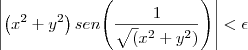
então

.
Sabemos que

. Então vamos lá:
Seja
; tomemos

( a preencher).
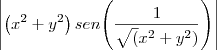
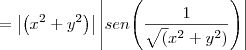
Como
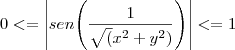
, então devemos ter

.
Assim podemos preencher a lacuna acima com

e concluímos que:
Seja
; tomemos
então
sempre que

ou seja:

.
E então o que vocês acham? Críticas, sugestões ...
Abç,
Francisco.
-
fraol
- Colaborador Voluntário
-
- Mensagens: 392
- Registrado em: Dom Dez 11, 2011 20:08
- Localização: Mogi das Cruzes-SP
- Formação Escolar: GRADUAÇÃO
- Área/Curso: Matemática
- Andamento: formado
por Renato_RJ » Qui Dez 29, 2011 22:53
Gostei, me parece correto... Eu parti logo para o Teorema do Confronto, acho mais tranquilo de fazer esse tipo de exercício...
[ ]'s
Renato.
Iniciando a minha "caminhada" pela matemática agora... Tenho muito o quê aprender...
-
Renato_RJ
- Colaborador Voluntário
-
- Mensagens: 306
- Registrado em: Qui Jan 06, 2011 15:47
- Formação Escolar: PÓS-GRADUAÇÃO
- Área/Curso: Mestrado em Matemática
- Andamento: cursando
Voltar para Cálculo: Limites, Derivadas e Integrais
Se chegou até aqui, provavelmente tenha interesse pelos tópicos relacionados abaixo.
Aproveite a leitura. Bons estudos!
-
- [limites] reciso de ajuda nessa questão de limites raiz quad
por alexia » Ter Nov 15, 2011 19:55
- 1 Respostas
- 5495 Exibições
- Última mensagem por LuizAquino

Qua Nov 16, 2011 15:16
Cálculo: Limites, Derivadas e Integrais
-
- [Limites]Preciso de ajuda para calcular alguns limites
por Pessoa Estranha » Ter Jul 16, 2013 17:15
- 2 Respostas
- 4819 Exibições
- Última mensagem por LuizAquino
Qua Jul 17, 2013 09:12
Cálculo: Limites, Derivadas e Integrais
-
- [Limites] Ajuda com limites no infinito e continuidade
 por umbrorz » Dom Abr 15, 2012 00:54
- 3 Respostas
- 4861 Exibições
- Última mensagem por umbrorz
Seg Abr 16, 2012 11:46
Cálculo: Limites, Derivadas e Integrais
-
- [limites] exercicio de calculo envolvendo limites
por lucasdemirand » Qua Jul 10, 2013 00:45
- 1 Respostas
- 4942 Exibições
- Última mensagem por e8group
Sáb Jul 20, 2013 13:08
Cálculo: Limites, Derivadas e Integrais
-
- [Limites] Dúvida sobre limites laterais
por Subnik » Sáb Abr 04, 2015 18:24
- 1 Respostas
- 2830 Exibições
- Última mensagem por DanielFerreira
Dom Abr 12, 2015 16:10
Cálculo: Limites, Derivadas e Integrais
Usuários navegando neste fórum: Nenhum usuário registrado e 20 visitantes
Assunto:
cálculo de limites
Autor:
Hansegon - Seg Ago 25, 2008 11:29
Bom dia.
Preciso de ajuda na solução deste problema, pois só chego ao resultado de 0 sobre 0.
Obrigado
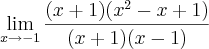
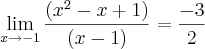
\lim_{x\rightarrow-1} x³ +1/x²-1[/tex]
Assunto:
cálculo de limites
Autor:
Molina - Seg Ago 25, 2008 13:25

Realmente se você jogar o -1 na equação dá 0 sobre 0.
Indeterminações deste tipo você pode resolver por L'Hôpital
que utiliza derivada.
Outro modo é transformar o numerador e/ou denominador
para que não continue dando indeterminado.
Dica: dividir o numerador e o denominador por algum valor é uma forma que normalmente dá certo.

Caso ainda não tenha dado uma

, avisa que eu resolvo.
Bom estudo!
Assunto:
cálculo de limites
Autor:
Guill - Dom Abr 08, 2012 16:03

Powered by phpBB © phpBB Group.
phpBB Mobile / SEO by Artodia.