por KleinIll » Qua Out 31, 2012 15:04
![\lim_{x\rightarrow\infty} \frac{\sqrt[2]{9{x}^{6} - x}}{{x}^{3} + 1}](/latexrender/pictures/560fec3af25eb7c0b7047a94f7ce3284.png "\lim_{x\rightarrow\infty} \frac{\sqrt[2]{9{x}^{6} - x}}{{x}^{3} + 1}")
Alguém pode explicar como resolver?
Reposta: 3
??? ?? ? ????, ? ? ??????.
-

KleinIll
- Usuário Dedicado

-
- Mensagens: 46
- Registrado em: Qua Out 31, 2012 14:17
- Formação Escolar: PÓS-GRADUAÇÃO
- Área/Curso: Engenharia Química
- Andamento: formado
por MarceloFantini » Qua Out 31, 2012 19:04

,
logo

.
Futuro MATEMÁTICO
-
MarceloFantini
- Colaborador Moderador

-
- Mensagens: 3126
- Registrado em: Seg Dez 14, 2009 11:41
- Formação Escolar: GRADUAÇÃO
- Andamento: formado
por KleinIll » Qua Out 31, 2012 23:50
MarceloFantini escreveu:,
logo
.
Obrigado, mas eu ainda não entendi. Se não for abusar, poderia explicar porque o limite é igual a três?
??? ?? ? ????, ? ? ??????.
-
KleinIll
- Usuário Dedicado
-
- Mensagens: 46
- Registrado em: Qua Out 31, 2012 14:17
- Formação Escolar: PÓS-GRADUAÇÃO
- Área/Curso: Engenharia Química
- Andamento: formado
por KleinIll » Sex Nov 02, 2012 10:25
MarceloFantini escreveu:Lembre-se do limite

. Consequentemente,

para

. A partir daí, usando as propriedades de limite, temos


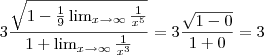
.
Perfeito! Muito obrigado.
??? ?? ? ????, ? ? ??????.
-
KleinIll
- Usuário Dedicado
-
- Mensagens: 46
- Registrado em: Qua Out 31, 2012 14:17
- Formação Escolar: PÓS-GRADUAÇÃO
- Área/Curso: Engenharia Química
- Andamento: formado
Voltar para Cálculo: Limites, Derivadas e Integrais
Se chegou até aqui, provavelmente tenha interesse pelos tópicos relacionados abaixo.
Aproveite a leitura. Bons estudos!
-
- [limites no infinito]Limite no infinito de um ponto finito
por moyses » Ter Ago 30, 2011 12:45
- 3 Respostas
- 3559 Exibições
- Última mensagem por LuizAquino

Ter Ago 30, 2011 18:57
Cálculo: Limites, Derivadas e Integrais
-
- [Limite] limite trigonométrico quando x tende ao infinito
por Ge_dutra » Seg Jan 28, 2013 10:13
- 2 Respostas
- 7323 Exibições
- Última mensagem por Ge_dutra
Ter Jan 29, 2013 14:20
Cálculo: Limites, Derivadas e Integrais
-
- [Limite] Questão de limite tendendo à infinito
por _bruno94 » Sex Mai 31, 2013 00:28
- 3 Respostas
- 2979 Exibições
- Última mensagem por Jhonata
Sex Mai 31, 2013 01:30
Cálculo: Limites, Derivadas e Integrais
-
- [LIMITE] Limite que tende ao infinito
por Mell » Qua Mai 08, 2013 00:09
- 3 Respostas
- 2657 Exibições
- Última mensagem por e8group
Qua Mai 08, 2013 21:21
Cálculo: Limites, Derivadas e Integrais
-
- Limite infinito
por VFernandes » Sex Mar 04, 2011 17:13
- 4 Respostas
- 3985 Exibições
- Última mensagem por LuizAquino
Sex Mar 04, 2011 21:48
Cálculo: Limites, Derivadas e Integrais
Usuários navegando neste fórum: Nenhum usuário registrado e 36 visitantes
Assunto:
[Função] do primeiro grau e quadratica
Autor:
Thassya - Sáb Out 01, 2011 16:20
1) Para que os pontos (1,3) e (-3,1) pertençam ao grafico da função f(X)=ax + b ,o valor de b-a deve ser ?
2)Qual o maior valor assumido pela função f : [-7 ,10] em R definida por f(x) = x ao quadrado - 5x + 9?
3) A função f, do primeiro grau, é definida pos f(x)= 3x + k para que o gráfico de f corte o eixo das ordenadas no ponto de ordenada 5 é?
Assunto:
[Função] do primeiro grau e quadratica
Autor:
Neperiano - Sáb Out 01, 2011 19:46
Ola
Qual as suas dúvidas?
O que você não está conseguindo fazer?
Nos mostre para podermos ajudar
Atenciosamente
Assunto:
[Função] do primeiro grau e quadratica
Autor:
joaofonseca - Sáb Out 01, 2011 20:15
1)Dados dois pontos A=(1,3) e B=(-3,1) de uma reta, é possivel definir a sua equação.


Em

substitui-se
m, substitui-se
y e
x por um dos pares ordenados, e resolve-se em ordem a
b.

2)Na equação

não existem zeros.Senão vejamos
Completando o quadrado,

As coordenadas do vertice da parabola são

O eixo de simetria é a reta

.Como se pode observar o vertice está acima do eixo Ox, estando parabola virada para cima, o vertice é um mínimo absoluto.Então basta calcular a função para os valores dos extremos do intervalo.
f(-7)=93
f(10)=59
Powered by phpBB © phpBB Group.
phpBB Mobile / SEO by Artodia.